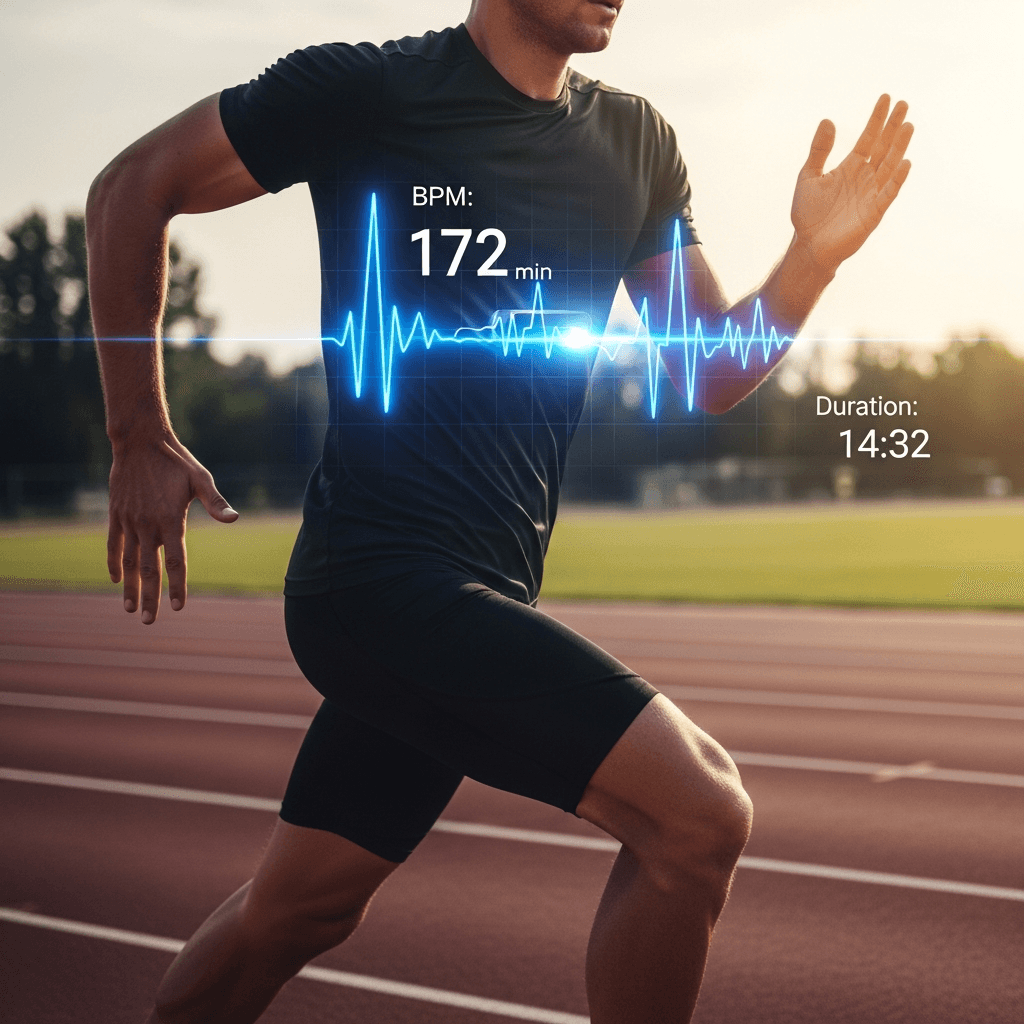
VO2max is the maximum rate at which your body can consume oxygen during maximal exercise, expressed in milliliters of oxygen per kilogram of body weight per minute (mL/kg/min). It is the gold standard measure of aerobic fitness and a strong predictor of endurance performance — a runner with a higher VO2max can, all else equal, sustain a faster pace before running out of aerobic capacity. Understanding and improving your VO2max is one of the highest-leverage investments you can make in your running.
Why VO2max Matters
Your muscles run on ATP (adenosine triphosphate). The aerobic energy system produces ATP using oxygen — it's efficient, sustainable for long durations, and produces primarily water and CO2 as byproducts. The anaerobic system produces ATP without oxygen — faster, but produces lactate, and can only be sustained for minutes.
VO2max determines the ceiling of your aerobic system. The higher it is, the more ATP you can produce aerobically per minute, and the faster you can run while staying primarily aerobic. For endurance sports, almost all performance beyond 2 minutes is aerobically dominated.
Key relationships:
- VO2max sets your absolute aerobic ceiling
- Lactate threshold determines how close to that ceiling you can race
- Running economy determines how much oxygen each stride requires
Improving any of the three improves performance. VO2max training is the most direct way to raise the ceiling.
The VO2max Formula
VO2max is formally measured in a lab using expired gas analysis during a maximal exercise test. The laboratory formula:
VO2max = (Volume of O2 consumed − Volume of O2 expired) / Body weight in kg
In practice, this requires a metabolic cart, mouthpiece, and maximal effort to exhaustion — not something you can do at home. Instead, several field tests estimate VO2max with reasonable accuracy.
Cooper Test (12-Minute Run)
Run as far as possible in 12 minutes on a flat surface. Then:
Estimated VO2max = (Distance in meters − 504.9) / 44.73
Example: You cover 2,800 meters in 12 minutes. VO2max = (2800 − 504.9) / 44.73 = 51.3 mL/kg/min
1.5-Mile (2.4km) Time Test
Run 1.5 miles as fast as possible. Then:
VO2max = 3.5 + 483 / (time in minutes)
Example: You complete 1.5 miles in 11 minutes. VO2max = 3.5 + 483 / 11 = 47.5 mL/kg/min
Garmin / Polar / Apple Watch Estimate
Most GPS watches now estimate VO2max from heart rate and pace data during runs. These estimates can be off by 3–5 mL/kg/min compared to lab tests, but they're useful for tracking trends over time. What matters most isn't the absolute number — it's whether it's going up.
VO2max Norms by Age and Gender
VO2max declines with age at roughly 1% per year after age 25 in sedentary individuals, and more slowly (0.5% per year) in consistently trained athletes. The following norms are based on American College of Sports Medicine (ACSM) classifications.
Men — VO2max (mL/kg/min)
| Age | Poor | Fair | Good | Excellent | Superior |
|---|---|---|---|---|---|
| 20–29 | < 34 | 34–37 | 38–44 | 45–51 | > 51 |
| 30–39 | < 31 | 31–35 | 36–43 | 44–49 | > 49 |
| 40–49 | < 29 | 29–33 | 34–40 | 41–47 | > 47 |
| 50–59 | < 26 | 26–30 | 31–37 | 38–44 | > 44 |
| 60–69 | < 22 | 22–26 | 27–33 | 34–40 | > 40 |
Women — VO2max (mL/kg/min)
| Age | Poor | Fair | Good | Excellent | Superior |
|---|---|---|---|---|---|
| 20–29 | < 25 | 25–30 | 31–37 | 38–44 | > 44 |
| 30–39 | < 24 | 24–28 | 29–35 | 36–42 | > 42 |
| 40–49 | < 21 | 21–25 | 26–31 | 32–38 | > 38 |
| 50–59 | < 19 | 19–23 | 24–30 | 31–37 | > 37 |
| 60–69 | < 17 | 17–21 | 22–27 | 28–34 | > 34 |
Notable reference points:
- Recreational runner, male age 35: typically 40–48 mL/kg/min
- Elite amateur male runner: 55–65 mL/kg/min
- Elite professional male distance runner: 70–80 mL/kg/min
- All-time recorded: Oskar Svendsen (cyclist, 2012): 97.5 mL/kg/min
How to Improve VO2max
VO2max responds most strongly to training at or near your VO2max intensity — which corresponds roughly to Zone 4–5 heart rate, or roughly 90–100% of maximum heart rate. The following training types are ranked by evidence of VO2max improvement.
1. VO2max Intervals (Highest Impact)
These are the most direct stimulus for VO2max adaptation. The goal: spend time at your VO2max intensity (roughly your current 3–8 minute race pace).
Classic protocol: 4–6 × 4 minutes at VO2max pace, 3 minutes easy recovery
The 4-minute work period ensures you spend meaningful time near VO2max. The 3-minute recovery allows enough recovery to hit the target intensity again on the next interval.
VO2max pace: Approximately your current 5K race pace for most runners, or slightly faster. On a treadmill, set the pace to something you could sustain for 6–8 minutes with effort.
Session example:
- 15 min warm-up
- 5 × 4 min at VO2max pace / 3 min easy recovery jog
- 15 min cool-down
2. Long Intervals (10–15 minutes at Threshold)
Sustained efforts at 85–90% max HR for 10–15 minutes also drive VO2max improvement, particularly for athletes who haven't done much structured work.
Protocol: 2–3 × 10–15 minutes at tempo pace / 3–5 minutes recovery
3. Hill Repeats
Running uphill increases oxygen demand at a lower pace, making it safer on the joints than flat speed work at the same physiological intensity.
Protocol: 8–12 × 60–90 second hill sprints at hard effort / jog down recovery
4. HIIT and Supramaximal Intervals
For runners who are already trained, adding short supramaximal intervals (faster than VO2max pace, 20–60 seconds) alongside longer intervals can accelerate VO2max gains.
Tabata protocol (research-validated): 8 × 20 seconds at 170% VO2max / 10 seconds rest. This was shown in the original Tabata et al. (1996) study to improve VO2max by 7 mL/kg/min in 6 weeks in trained athletes.
How Quickly Can VO2max Improve?
| Training Status | Expected Gain per 8–12 Weeks | Notes |
|---|---|---|
| Sedentary / beginner | 15–25% | Most gains come from any consistent training |
| Recreational (1–2 years) | 5–15% | Structured intervals accelerate gains |
| Well-trained (3–5+ years) | 3–8% | Harder to improve, requires precise training |
| Elite | 1–3% | Near genetic ceiling; marginal gains |
VO2max gains plateau when you approach your genetic ceiling, which is largely determined by cardiac stroke volume, mitochondrial density, and oxygen-carrying capacity. Training can develop most people toward their ceiling but cannot exceed it.
VO2max vs. Running Economy: Which Should You Train?
A common misconception: a higher VO2max always means faster racing. It doesn't. Running economy — how much oxygen a runner uses at a given pace — determines how much of your VO2max you use to run a particular speed.
| Metric | What It Measures | How to Improve |
|---|---|---|
| VO2max | Aerobic ceiling (oxygen uptake capacity) | Intervals, HIIT, hill sprints |
| Lactate threshold | % of VO2max you can race at | Tempo runs, Zone 4 work |
| Running economy | Oxygen cost of a given pace | Mileage, strength work, drills |
For most runners below 50 mL/kg/min, improving VO2max through targeted interval work will produce the most immediate race performance gains. For runners above 55 mL/kg/min, running economy and lactate threshold become larger limiters.
How FlipMP Tracks Your VO2max Progress
FlipMP reads your VO2max estimate directly from Garmin, Polar, and Apple Watch devices. If your device tracks VO2max over time (Garmin calls it "VO2max estimate," Polar calls it "VO2max," Apple Watch calls it "Cardio Fitness"), FlipMP plots it on your dashboard so you can see the trend across months and training blocks.
The AI coach correlates changes in your VO2max with training load — showing whether your current interval volume is actually moving the needle, or whether you're doing too much easy running without enough high-intensity stimulus.
See your aerobic capacity trends on FlipMP →