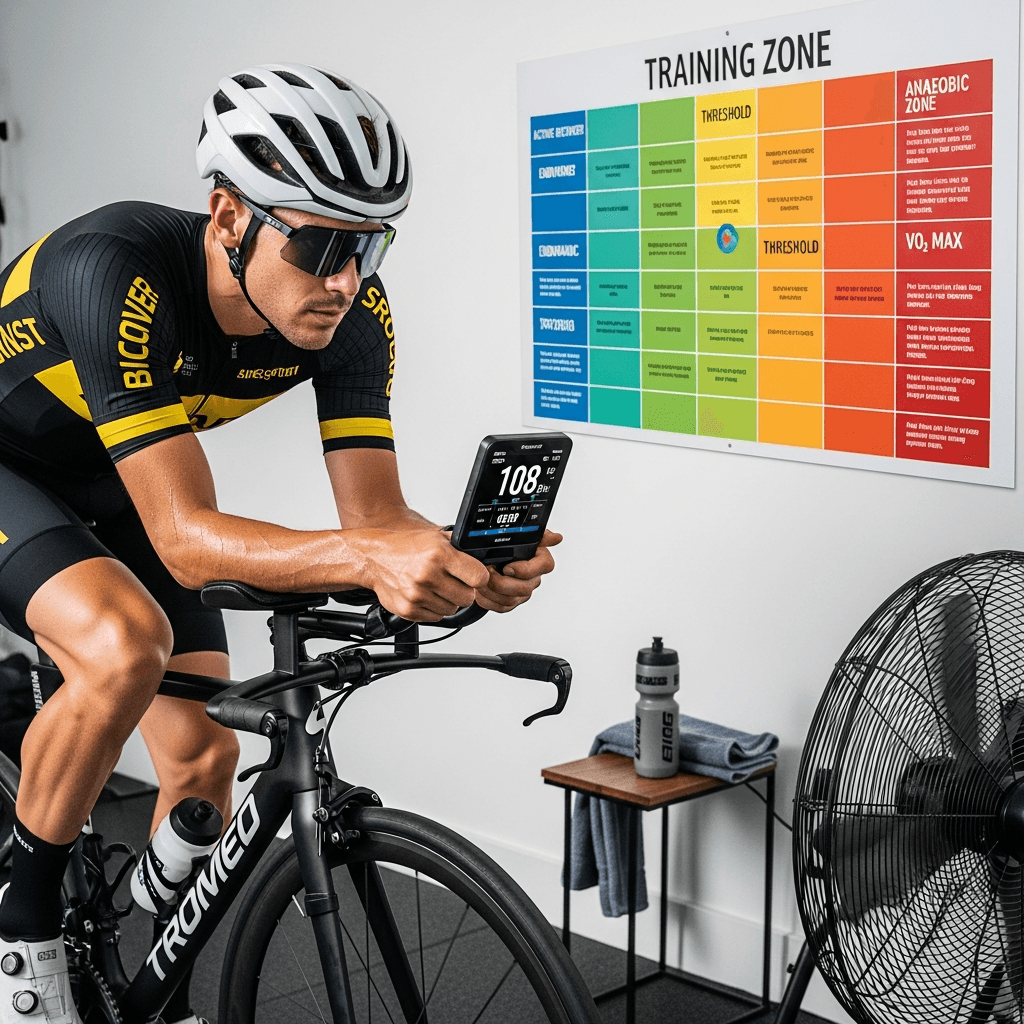
Cycling power zones are percentage ranges of your Functional Threshold Power (FTP) that correspond to specific physiological intensity levels. The 7-zone system developed by Dr. Andrew Coggan is the standard framework used by coaches and athletes worldwide. Each zone targets a different energy system, produces different adaptations, and should constitute a specific proportion of your weekly training volume. Understanding zones transforms vague "ride hard" sessions into precise, targeted workouts with predictable outcomes.
If you haven't tested your FTP yet, read the FTP Test Guide first. Every zone in this article is a percentage of that number.
The 7-Zone Power System
| Zone | Name | % FTP | Example (FTP = 250W) | How It Feels |
|---|---|---|---|---|
| Zone 1 | Active Recovery | < 55% | < 138W | Effortless, no fatigue, could go for hours |
| Zone 2 | Endurance | 56–75% | 140–188W | Comfortable, slightly aware you're working, conversation easy |
| Zone 3 | Tempo | 76–90% | 190–225W | Moderately hard, aware of breathing, short conversations |
| Zone 4 | Lactate Threshold | 91–105% | 228–263W | Hard and sustained, breathing heavy, few words at a time |
| Zone 5 | VO2max | 106–120% | 265–300W | Very hard, labored breathing, 3–8 minute efforts maximum |
| Zone 6 | Anaerobic Capacity | 121–150% | 303–375W | Near-maximal, short bursts, 30 seconds–2 minutes |
| Zone 7 | Neuromuscular Power | > 150% | > 375W | All-out sprint, 5–15 seconds |
Zone 1 — Active Recovery
% FTP: Below 55% Duration: Up to several hours Heart rate: Zone 1 (50–60% max HR)
Zone 1 is often mislabeled as "easy riding" — it's actually a specific recovery modality. At this power output, you're cycling with almost no metabolic stress. Blood moves through fatigued muscle tissue, clearing metabolites from hard sessions without adding new training load.
When to use it:
- The day after a hard session or race
- Recovery days during high-volume training blocks
- Cool-down after threshold or VO2max work
- Active recovery between intervals (at or below Zone 1)
Common mistake: Riding too hard on recovery days. If you can't keep your power below 55% FTP without effort, you're not recovering — you're adding stress. Zone 1 often requires consciously holding back, especially on hills.
Zone 2 — Endurance
% FTP: 56–75% Duration: 1–6+ hours Heart rate: Zone 2 (60–70% max HR)
Zone 2 is the aerobic base zone and the most important intensity band for long-term cycling development. Training here stimulates mitochondrial biogenesis (more mitochondria per muscle cell), improves fat oxidation, increases capillary density, and builds the aerobic engine that supports all other training.
Elite cyclists spend 70–80% of their total training volume in Zone 2. This is called "polarized training" — the majority of riding easy, with a smaller fraction at higher intensities. Recreational cyclists often invert this, doing most riding at Zone 3–4, which creates chronic fatigue without the same aerobic base adaptations.
When to use it:
- Long endurance rides (2–6 hours)
- Recovery rides that are slightly longer and involve more stimulus than Zone 1
- Base building phase, especially winter training
- Any ride where the goal is volume without accumulating fatigue
Hallmark of Zone 2: You can hold a conversation easily and feel like you could ride for a very long time. If you're on a climb and drift into Zone 3, that's acceptable; the average power across the ride should be in Zone 2.
Zone 3 — Tempo
% FTP: 76–90% Duration: 30–90 minutes Heart rate: Zone 3 (70–80% max HR)
Tempo riding develops aerobic efficiency — your ability to sustain a moderately hard effort for extended periods. It sits between comfortable endurance and hard threshold work, which is why some coaches call Zone 3 the "sweet spot" (it feels productive and is sustainable), while others call it the "gray zone" (it accumulates fatigue without the maximal aerobic stimulus of Zone 4–5).
Both perspectives have merit. Zone 3 has a role, but shouldn't be your default "I'll ride moderately hard" intensity. Use it deliberately.
When to use it:
- Tempo intervals: 2–4 × 15–20 minutes at Zone 3 with 5-minute recovery
- Sustained medium-length climbs at controlled effort
- Late base/early build phase to transition from pure endurance to harder work
- Any ride where you want slightly more stimulus than Zone 2 without the full fatigue of Zone 4
Sweet spot training: The overlap between Zone 3 and Zone 4 (roughly 88–93% FTP) is called "sweet spot" by many coaches. Sweet spot training provides ~85% of the adaptation of threshold work at ~60% of the fatigue cost. It's especially useful for time-constrained athletes who can't do long Zone 2 rides but need more volume than Zone 4 allows.
Zone 4 — Lactate Threshold
% FTP: 91–105% Duration: 10–60 minutes Heart rate: Zone 4 (80–90% max HR)
Zone 4 is your FTP zone — efforts right at or just above the intensity you could sustain for an hour. Training here drives your primary performance-related adaptation: raising your lactate threshold.
The lactate threshold is the intensity at which lactate begins accumulating faster than your body can clear it. When you raise this threshold, you can ride faster before crossing that line. This is the single most impactful adaptation for competitive cycling performance.
When to use it:
- Classic threshold intervals: 2–3 × 20 minutes at 95–105% FTP with 5 minutes rest
- Longer single-threshold efforts: 30–50 minutes at 95% FTP
- Race-pace training for time trials
- Build phase, once Zone 2 base is established
Pacing Zone 4 work: The key to productive threshold intervals is consistency. Riding at 105% FTP for the first half and blowing up produces less adaptation than a steady 95–100% throughout. Use a power meter to hold your target band.
Zone 5 — VO2max
% FTP: 106–120% Duration: 3–8 minutes per interval Heart rate: Zone 5 (90–100% max HR)
VO2max intervals target your maximum aerobic capacity — the ceiling of your aerobic system. These efforts push you to near-maximal oxygen consumption and produce the strongest stimulus for VO2max improvement. They are also the most fatiguing intervals in your training week.
Classic protocols:
- Norwegian model: 4–5 × 4–5 minutes at 110–115% FTP / 3 minutes recovery
- Billat protocol: 4–6 × 4 minutes at vVO2max / 4 minutes recovery
- 30/30s: 10–20 × 30 sec at 120% FTP / 30 sec recovery (less classic but accessible)
When to use it:
- Once per week maximum, ideally after Zone 2 volume is established
- Build phase and early race-specific phase
- Athletes specifically targeting 5km–20km time trial performance
Recovery requirement: VO2max sessions require 48 hours of easy riding before and after. Never schedule two Zone 5 sessions within 48 hours.
Zone 6 — Anaerobic Capacity
% FTP: 121–150% Duration: 30 seconds–2 minutes Heart rate: Not meaningful (HR can't respond fast enough to track this zone)
Zone 6 develops your anaerobic capacity — the total amount of energy your glycolytic system can produce above the aerobic threshold. This is the zone that determines your ability to sustain hard accelerations, attacks on climbs, and surges in a group ride.
Protocols:
- Sprint intervals: 6–10 × 1 minute at 130–140% FTP / 4 minutes recovery
- Micro-intervals: 15–20 × 30 sec at 140% FTP / 30 sec recovery
- All-out 1-minute efforts: 5–8 × 1 min max effort / 5 min rest
When to use it:
- Criterium and road race preparation
- Athletes who fade in surges or when being attacked
- Late build and race-specific phase
- Riders who can sustain threshold but can't accelerate out of corners or over short climbs
Zone 7 — Neuromuscular Power
% FTP: Above 150% Duration: 5–15 seconds Heart rate: Not relevant
Zone 7 is pure sprint power — the absolute maximal neuromuscular output your body can produce. These are 5–15 second all-out efforts that recruit maximum fast-twitch muscle fibers and train your neuromuscular system for explosive acceleration.
Protocols:
- 6–10 × 10–15 second sprints from a rolling start / 5 minutes full recovery
- Standing starts: 5–8 × 10 sec seated then standing sprint / 5 min rest
When to use it:
- Track cyclists, sprinters, criterium racers
- Any cyclist who wants to improve closing sprint, attack power, or acceleration from stops
- Can be added to most riding programs as they have low aerobic fatigue (short duration) but require good recovery between efforts
Zone Distribution for a Training Week
Here's how a well-structured cycling week might distribute zones for different types of cyclists:
| Athlete Type | Zone 1–2 | Zone 3 | Zone 4 | Zone 5–6 |
|---|---|---|---|---|
| Recreational (3–5 hrs/wk) | 60% | 25% | 10% | 5% |
| Amateur racer (8–12 hrs/wk) | 70% | 10% | 15% | 5% |
| Competitive amateur (12+ hrs/wk) | 75% | 5% | 15% | 5% |
| Elite/professional | 80% | 5% | 10% | 5% |
Notice that as training volume and experience increases, the proportion of Zone 2 increases and Zone 3 decreases. Elite athletes train at very high volume in Zone 2 and concentrate their hard work in specific, targeted Zone 4–5 sessions.
How FlipMP Shows Your Zone Distribution
After every ride, FlipMP analyzes your power data and shows you exactly how much time you spent in each zone. The weekly and monthly views let you see whether your training distribution matches your goals.
If you're preparing for a time trial, FlipMP can track your Zone 4 volume and ensure you're hitting the right threshold work. If you're in a base phase and your Zone 3 percentage is creeping up, the AI coach will flag it and suggest adjusting your effort on long rides.
Connect your Garmin, Wahoo, Zwift, or Strava account and your zones populate automatically from your FTP.
Analyze your cycling power zones on FlipMP →