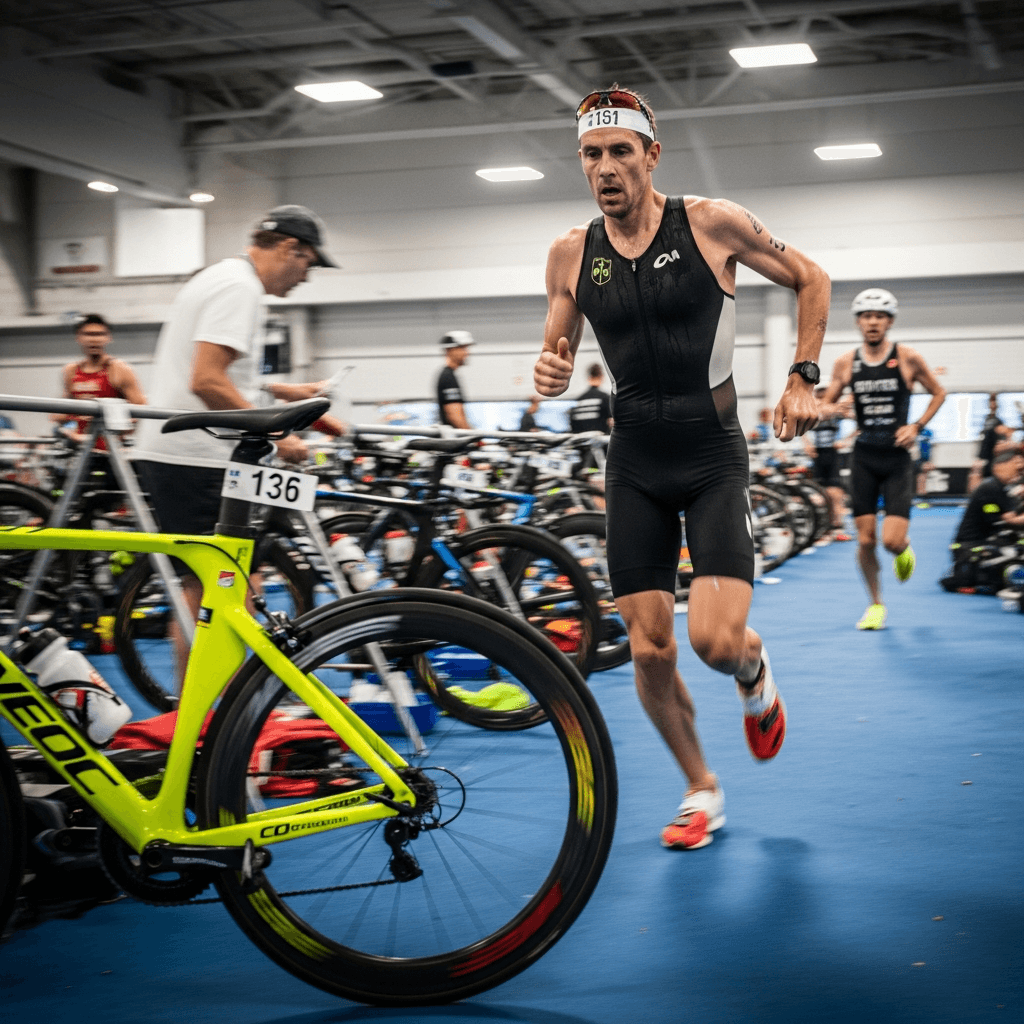
A brick workout combines two triathlon disciplines back-to-back — most commonly cycling immediately followed by running — with no rest between them. The name refers to how your legs feel at the start of the run: like bricks. The purpose is to train your neuromuscular system to transition between two very different movement patterns under fatigue, which is a skill that cannot be developed by training swim, bike, and run separately.
Every triathlete who wants to run well off the bike needs to do brick workouts. Here's why, how, and exactly what sessions to do.
The Physiology Behind the Brick Feeling
When you cycle, your quads, hip flexors, and glutes contract in a seated, rotational pattern — pedaling. When you stop cycling and begin running, these same muscles must immediately shift to a very different vertical, impact-absorbing pattern.
Several things happen neurologically and physiologically at this transition:
Motor pattern mismatch: Your nervous system is still sending cycling-pattern signals when you start running. The result is a brief period of coordination lag — your stride feels short, choppy, and unnatural.
Blood flow redistribution: During cycling, blood is pooled in the legs' cycling-specific muscle fibers. On the run, the demand pattern changes. The cardiovascular system takes 2–4 minutes to redistribute appropriately.
Venous pooling: Coming off the bike, gravity temporarily pools blood in the lower extremities as the leg muscles that were pumping blood centrally (during cycling) stop their rhythmic contractions. This can cause a brief drop in cardiac output and the sensation of lightheadedness.
Postural shift: Cycling keeps you in a forward lean, hip-flexed position for an extended period. Running requires upright posture and hip extension. Athletes who haven't practiced the transition struggle to stand tall in the first kilometer.
The good news: All of these effects diminish significantly with practice. After 4–6 weeks of regular brick sessions, most athletes reduce their brick feeling from 2–3 km to less than 500 meters — some feel almost nothing. The neuromuscular system adapts specifically to this transition with training.
How Often Should You Do Brick Workouts?
| Training Phase | Brick Frequency | Notes |
|---|---|---|
| Base phase (12+ weeks out) | Once every 2–3 weeks | Short transitions, focus on feel |
| Build phase (8–12 weeks out) | Once per week | Increase run duration off bike |
| Specific phase (4–8 weeks out) | Once per week, increasing specificity | Race-simulation distance and pace |
| Peak/Taper (1–3 weeks out) | Once, race-simulation | Short; don't fatigue before race |
For sprint triathlon preparation, 1 brick per week for the final 6–8 weeks of training is standard and sufficient. For longer races (Olympic, 70.3), brick workouts become more critical and should be a weekly fixture for 10–16 weeks.
5 Brick Sessions for Every Level
Session 1: The Short Transition Brick (Beginner)
Purpose: First exposure to the bike-to-run transition; build neuromuscular awareness.
| Phase | Duration/Distance | Intensity |
|---|---|---|
| Warm-up | 10 min bike, easy | Zone 1–2 |
| Bike | 20 min | Zone 2 (easy) |
| Transition | < 2 min | Change shoes only |
| Run | 10 min | Zone 2, comfortable |
| Cool-down | 5 min walk | Easy |
Notes: The run is deliberately short. Your only goal is to feel what the transition is like and practice the logistics. Notice when the brick feeling fades — it gives you a benchmark for future sessions.
Session 2: The Classic 45/15 Brick (Intermediate)
Purpose: Race-simulation ratio; prepares you for the bike-to-run feel in a sprint.
| Phase | Duration/Distance | Intensity |
|---|---|---|
| Bike | 45 min | Zone 2–3, with 2×10 min at Zone 3 |
| Transition | < 90 sec | Practice fast T2 |
| Run | 15 min | Zone 2–3, first 5 min allow settling |
Notes: Keep the first 3–5 minutes of the run easy regardless of how strong you feel. The brick effect peaks at the start of the run; patience here prevents blowing up later.
Session 3: The Race-Simulation Brick (Sprint Triathlon)
Purpose: Full race-distance bike + run at race pace. The closest thing to a race.
| Phase | Distance | Intensity |
|---|---|---|
| Bike | 20 km | Race effort (Zone 3–4) |
| Transition | Race-speed T2 | Under 90 seconds |
| Run | 5 km | Race effort (Zone 3–4, faster in final km) |
Notes: Do this 3–4 weeks before race day. After this session, you'll know your T2 time, your run-off-bike pace, and your pacing strategy. Aim to run the second half of the 5km faster than the first (negative split).
Session 4: The Over-Distance Brick (Endurance Builder)
Purpose: Build durability; trains you to maintain run form under greater fatigue than race distance.
| Phase | Duration/Distance | Intensity |
|---|---|---|
| Bike | 30–45 km | Zone 2 steady |
| Transition | Normal T2 | — |
| Run | 8–10 km | Zone 2, conversational pace |
Notes: This is not a race-pace session. The goal is time under fatigue. Run form quality matters more than speed. If your form degrades significantly (forward lean, shuffle step), slow down.
Session 5: Multi-Brick (Race Fitness Check)
Purpose: Simulate race fatigue by doing multiple transition cycles in one session.
| Phase | Duration | Intensity |
|---|---|---|
| Bike | 20 min | Zone 2–3 |
| Run | 10 min | Zone 2–3 |
| Rest | 5 min | Walk, transition |
| Bike | 20 min | Zone 2–3 |
| Run | 10 min | Zone 2–3 |
Notes: Two cycles with a brief transition between each. This session is more fatiguing than a single brick. Use it 4–6 weeks out from a race to check overall durability. Compare your pace and HR in the second brick versus the first — a significant drop indicates you need more volume.
Transition Efficiency: Making Bricks Count
The brick workout is also the best opportunity to rehearse T2 mechanics. Every second you save in transition is a second you don't have to earn on the run course.
T2 setup practice:
- Dismount at the line, not at your rack
- Rack by the front wheel (push bar goes under the rail)
- Remove helmet after racking
- Pre-tied shoes or elastic laces save 15–30 seconds
- Race belt attached before the run, not during
- Practice this sequence 5–10 times outside your brick session until it's automatic
Target T2 times:
- Beginner: under 3 minutes
- Intermediate: under 2 minutes
- Advanced: under 90 seconds
- Elite: 30–60 seconds
Common Brick Workout Mistakes
Going Too Hard on the Bike
Most triathletes push too hard on the bike leg in training and arrive at the run already depleted. For most brick workouts, the bike should be Zone 2–3, not race effort. Save race-pace bike work for dedicated race-simulation sessions (Session 3 above).
Skipping the Run Entirely
Sometimes athletes do a long bike session and skip the run "because they're tired." The transition run doesn't have to be long — even 10 minutes counts. The neurological adaptation requires the bike-to-run transition, not just volume.
Training Bricks Too Infrequently
Once a month isn't enough to develop the neuromuscular adaptation. The adaptation is specific and requires repeated practice. One brick per week in the final 6–8 weeks before a race is the minimum effective dose.
How FlipMP Helps Triathletes Track Bricks
The challenge with bricks is that they span two sports — your GPS device might split the data as two separate activities, or combine them. FlipMP's multi-sport activity support recognizes brick sessions and displays them as a single combined workout with segments for each discipline.
The AI coach tracks your run pace off the bike over multiple brick sessions, so you can see whether your bike-to-run transition is improving. If your first kilometer of each run brick is getting progressively faster, your neuromuscular adaptation is working.