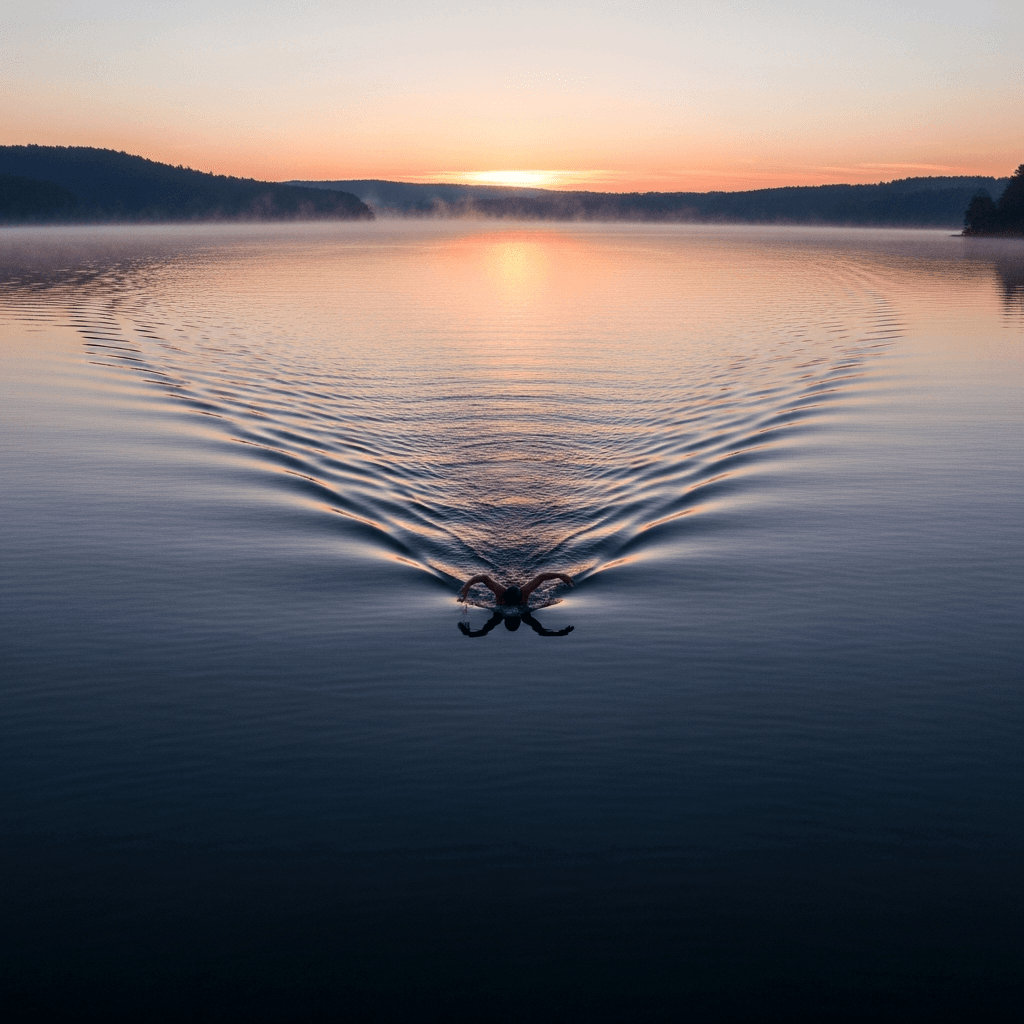
Open water swimming is fundamentally different from pool swimming — and not just because you can't see the bottom. The absence of lane lines, black lines on the floor, walls to push off, and lane markers changes almost every skill and challenge you've developed in the pool. The good news: every open water skill is learnable, and the preparation is straightforward if you know what to practice.
This guide covers safety fundamentals, sighting technique, wetsuit selection, cold water acclimatization, and how to handle the physical and psychological demands of open water in a race.
Open Water Safety Checklist
Never swim in open water alone. This isn't a guideline — it's a hard rule. Beyond that, here's a pre-swim safety check for every open water session:
Before you enter:
- Swim with at least one other person, or have a support kayak/paddleboard nearby
- Wear a brightly colored swim cap (makes you visible to boats and support crew)
- Use a tow float or inflatable swim buoy — clips to your waist, floats behind you, makes you visible, and provides an emergency rest point
- Know the water temperature (use a thermometer or check local reports)
- Know the exit points — where can you get out quickly if needed?
- Tell someone who is not swimming where you're going and when you expect to return
- Check for currents, boat traffic, or hazards specific to that body of water
- Check weather — lightning means no water, full stop
Know the signs of cold water shock:
- Sudden cold water triggers an involuntary gasp reflex
- Heart rate and blood pressure spike dramatically
- Hyperventilation sets in within seconds
- At risk temperatures: below 15°C (59°F)
Prevent cold water shock by entering gradually (see Acclimatization section below). Never jump into cold open water head-first.
Warning signs during swimming:
- Sudden fatigue or loss of coordination
- Numbness in hands and feet (early hypothermia)
- Confusion or difficulty tracking your location
- Panic or inability to control breathing
If you experience any of these, roll onto your back, float, signal for help, and do not attempt to continue swimming.
Sighting Technique
In a pool, you have a black line and walls. In open water, you have buoys (often 50–200 meters away), other swimmers (unreliable), and whatever is on the shoreline. Sighting is the skill of lifting your eyes out of the water to spot your target and maintain a straight course.
Why Sighting Matters
Without sighting, even experienced swimmers drift. Most swimmers have a slight asymmetry in their stroke — one side is stronger, one arm pulls slightly wider — which creates a natural curve over distance. Without sighting, a 750-meter swim can become 900+ meters. In a triathlon, that's 1–2 minutes of wasted time and unnecessary fatigue.
The Sighting Technique
Step 1: The sight — As your lead hand enters the water, briefly lift your eyes just above the surface before rotating to breathe. Keep your chin on the water; you only need to see 1–3 inches above the surface to spot a buoy. Don't lift your head fully out of the water — this drops your hips and creates drag.
Step 2: Breathe — After sighting, rotate your head to your normal breathing side and take your breath as usual.
Step 3: Adjust course — Make small, gradual corrections. Sudden course changes waste energy.
Frequency: In calm conditions, sight every 8–12 strokes. In rough water, waves, or crowded starts, sight every 4–6 strokes. When approaching a buoy turn, sight every 4 strokes to nail the turn.
Sighting Landmarks
Don't rely solely on buoys — especially in race chaos where you may lose sight of them. Pre-swim, identify landmarks on the far shore:
- A tree, building, or tower directly behind the buoy line
- The color or shape of a shoreline structure
- The angle of the sun relative to your direction of travel
If you lose the buoy, swim toward your landmark until you reacquire it.
Drafting Legally in Open Water
Unlike cycling, drafting (swimming close behind another swimmer) is completely legal in open water triathlon. Swimming in another swimmer's "slipstream" reduces your effort by 10–20%. Find a swimmer who is slightly faster than you and positions on their feet or diagonal hip. Open water swimming is one of the rare situations where keeping up with someone faster than you is worth the effort — their draft effect reduces the cost.
Wetsuit Selection Guide
Wetsuits provide buoyancy, warmth, and hydrodynamic advantages. A wetsuit lifts your legs and hips to a flatter body position, which reduces drag and makes swimming easier. Most triathletes swim 5–10% faster in a wetsuit than without one.
Temperature Rules
| Water Temperature | Wetsuit Status |
|---|---|
| Below 18°C (64°F) | Strongly recommended; required at some races |
| 18–22°C (64–72°F) | Wetsuit legal (permitted, optional) |
| 22–24.9°C (72–77°F) | Wetsuit legal but check race rules; ITU bans above 22°C |
| 25°C+ (77°F+) | Wetsuit illegal in most race organizations |
Different race organizations (ITU, WTC Ironman, local clubs) have slightly different cutoffs. Always check your specific race rules.
Wetsuit Types
Full suits: Cover arms and legs. Maximum warmth and buoyancy. Best for cold water (below 20°C). Slightly more restrictive shoulder movement — look for wetsuit-specific shoulder panels ("arm flexibility panels") that allow a natural high-elbow catch.
Sleeveless (farmer john/jane): No arms. Better shoulder mobility, less warmth. Ideal for warmer water (18–22°C) or swimmers who prioritize stroke freedom over maximum buoyancy.
Neoprene shorts/bottoms: Minimal coverage, maximum mobility. Used primarily in very warm conditions or by elite swimmers who don't need the buoyancy assist.
What to Look For in a Triathlon Wetsuit
Buoyancy panels: Thicker neoprene (5mm) on the legs and hips provides more lift. Thinner neoprene (1.5–3mm) on the arms and shoulders allows mobility.
Neck and wrist seals: Must be snug but not uncomfortable. Loose seals allow water to flush in; too tight causes constriction and anxiety.
Zipper placement: Back zippers are most common. Some race wetsuits have no zipper (speedsuits) — these are very fast but require more time to remove.
Fit: The most important factor. A wetsuit that fits perfectly outperforms an expensive wetsuit that fits poorly. Try before buying if possible. When properly fitted, you shouldn't be able to pinch much neoprene away from your body in the torso section.
Cost: Entry-level full suits (Xterra Vector, Blue Seventy Reaction): $150–$250. Mid-range (Orca Athlex): $350–$500. High-end race suits (Roka Maverick Pro, Zone3 Vanquish): $600–$900+.
Wetsuit Removal Speed
Practice wetsuit removal. In a triathlon, T1 time is where slow wetsuit removal creates the biggest time losses.
Technique:
- Unzip as you exit the water (before reaching transition)
- Pull suit down to waist while running
- Step on one leg, pull out; step on the other, pull out
- Leave suit at your spot; don't carry it to your bike
With practice: 25–40 seconds. Without practice: 2–3 minutes. The difference is enormous in a race context.
Cold Water Acclimatization Protocol
Cold water shock is the biggest open water safety risk and the most common reason new swimmers panic in races. The good news: it's highly preventable with systematic exposure.
Target acclimatization temperature: Whatever temperature your race will be in.
4-Week Acclimatization Protocol
| Week | Session Frequency | Exposure Duration | Method |
|---|---|---|---|
| Week 1 | 2–3 × per week | 5–10 min | Wade in slowly, splash face, then swim |
| Week 2 | 3 × per week | 10–15 min | Enter slowly, controlled breathing before swimming |
| Week 3 | 3 × per week | 15–25 min | Normal open water session, focus on breathing control |
| Week 4 | 2–3 × per week | 20–30 min | Race-simulation duration |
The critical rule: Always enter cold water slowly. Wade in from knees to waist over 2–3 minutes. Splash water on your face and neck (the areas with the most cold-shock receptors) before submerging. This prevents the gasp reflex and allows your cardiovascular system to adapt.
Signs of successful acclimatization:
- No involuntary gasp when entering cold water
- Breathing remains controlled and rhythmic after submerging
- Gradual return of sensation to hands and feet (indicating your body is routing blood efficiently)
Race-Day Open Water Strategies
Before the Start
- Warm up in the water if allowed — even 5 minutes of easy swimming raises your heart rate, reduces cold shock response, and confirms your goggles are sealed
- Seed yourself honestly — start near the back or sides if you're a moderate swimmer, not in the front
- Identify your first buoy and your sighting landmark before entering
Managing the Start
Open water starts (especially mass starts) involve unavoidable contact: kicks, swipes, and being swum over. This is normal and not aggression.
If you feel panicked at the start:
- Roll onto your back immediately and float
- Take 5–10 deep, controlled breaths
- Breaststroke for 30–60 seconds to re-establish control
- Resume freestyle when breathing is normal
Starting on the outside of the swim field sacrifices some drafting but avoids the worst contact. For beginners, the outside is worth it.
Navigating the Course
- Count strokes between sights: 8–10 in calm water, 4–6 in chop
- At buoy turns, take a wide angle to avoid the crush of swimmers all turning at once
- Exit the water decisively — don't slow to a walk until you're fully out
How FlipMP Helps Open Water Swimmers
Tracking open water swim sessions presents a data challenge: pool laps are precise, but open water GPS tracks vary in accuracy and don't tell you about sighting frequency, straight-line efficiency (your actual distance vs. GPS distance), or how your heart rate differed from a pool swim at the same effort.
FlipMP imports open water swim data from Garmin and other devices, lets you add notes about conditions (temperature, chop, currents), and tracks your trend in open water pace compared to pool pace — a useful proxy for open water skills development.